Gameplay
Preliminaries
Sets
Chow - A sequence of three consecutively numbered tiles of the same suit.
Pung - A set of three identical tiles.
Kong - A set of four identical tiles.
Pair
Two identical tiles. A pair is not a set.
Special Hands
A special pattern of tiles that is scored differently from the usual.
Mah-Jong
Mah-Jong is declared when a player has a winning hand. A winning hand consists of either:
Four sets and one pair. The four sets can consist of:
max. 1 chow,
any number of pungs,
any number of kongs.
A pattern of tiles that matches a special hand, even if it does not satisfy the regular winning condition.
Hand, Round, Match
A hand begins with the rolling of the dice to break the wall and ends when someone declares Mah-Jong or the wall is exhausted.
A hand can also refer to an individual player’s hand of tiles, the meaning usually being clear from context.
After a hand is finished, the players’ Winds rotate counterclockwise unless the hand was drawn or the East Wind player won, in which case the Winds do not rotate.
A round is complete once each player has had a chance to be the East Wind player (at least four hands).
Each round has a designated prevailing Wind, starting with East. At the start of a new round, the prevailing Wind changes following the usual order (East, South, West, North).
A match ends after four complete rounds (at least sixteen hands).
Sequence of Events
The East Wind player begins the hand by discarding a tile (since they start with 14 tiles, unlike the other players, who start with 13 tiles) onto the table between the players.
Gameplay now follows the following sequence of events:
Any player may claim the most recently discarded tile if that tile completes a legal set for them or allows the player to declare Mah-Jong.
If nobody claims the discarded tile, play continues around the table in a counterclockwise direction from the discarding player. The next player draws a new tile from the wall and becomes the current player.
The current player then discards a tile, and this continues until either a player declares Mah-Jong or the wall is exhausted.
Drawing Tiles
Tiles are drawn from the open end of the wall, starting from where the original deal ended, in the clockwise direction, with both tiles of each stack taken before moving to the next.
Discarding Tiles
Tiles are discarded to the centre of the table. The discarding player must announce the name of the discarded tile. It is allowed to organise the discarded tiles on the table, but it is not required.
Claiming a Discard
Whenever a discard is laid on the table, any player may claim it if it completes a pung or a kong, or is used to declare Mah-Jong.
The player whose turn is naturally next can also claim a discard to complete a chow.
Any tile may be claimed for a Mah-Jong, even if it does not complete a pung or kong, or it completes a chow that would normally not be allowed due to player order. This means that a discard can be claimed to complete a pair or a special hand if it is the last tile needed for Mah-Jong.
To claim a discarded tile:
The player must announce the call (kong, pung, chow, or Mah-Jong).
If the tile is claimed to complete a set, the player exposes the tiles in their hand that comprise the target set, claims the tile, and places it with the rest of the set on the table in front of them.
If the tile is claimed for a Mah-Jong the current hand is finished. Proceed to scoring.
If the discard was claimed for a kong, the player draws a supplemental tile from the kong box. If the player now holds a winning hand, they may declare Mah-Jong at which point the current hand is finished. Proceed to scoring.
The player completes the action by discarding a tile.
If two players claim a discard, the priority is as follows:
The tile will be used to declare a Mah-Jong.
The tile will be used to declare a pung or kong.
The tile will be used to declare a chow.
In case of equal priority, the player who is earlier in the playing order from the discarding player gets the discarded tile.
When a tile is claimed, the turn passes to the player to the right of the claiming player after the discard, even if this causes some players to be skipped.
Bonus Tile Replacements
If a player draws a bonus tile (Flower or Season), they expose it face up in front of them and draw a replacement from the kong box. If another bonus tile is drawn, it is also immediately exposed and replaced again until that player holds no more bonus tiles. The game then proceeds as normal.
Additional Kong Rules
Declaring a Concealed Kong
If a player has four identical tiles in their hand, they may use them for a concealed kong. However, keeping all four tiles in their hand would mean they will never have enough tiles to complete a Mah-Jong. This is because a kong contains one tile more than a pung or chow. It is not possible to complete the three remaining sets and a pair with only ten tiles. To resolve this, a player may choose to declare a concealed kong.
To declare a concealed kong:
The player announces “kong”.
The player reveals the kong by exposing the tiles. However, the set is considered concealed.
To distinguish the kong as a concealed set, place the two edge tiles face down.

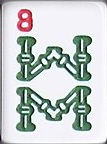
The player draws a supplemental tile from the kong box.
There is no obligation to declare a kong made of self-drawn tiles. A player may still choose to combine the tiles differently (e.g., use three of the tiles in a pung and the fourth in a chow). Once declared, the kong cannot be broken.
A concealed kong may be declared only during a player’s turn, i.e., between drawing a tile from the wall and discarding a tile from their hand. Claiming a discard does not begin a player’s turn, so a concealed kong cannot be declared while claiming a discard. Therefore, if a player claims a discard for a kong and the supplemental tile would enable them to declare a concealed kong, they must wait until their next draw to do so.
Promoting an Exposed Pung to an Exposed Kong
If a player with an exposed pung draws the fourth tile matching that pung, they may choose to promote the exposed pung to an exposed kong:
The player announces “kong”.
The player reveals the fourth tile and combines it with the exposed pung to form an exposed kong.
The player draws a supplemental tile from the kong box.
Promoting an exposed pung to a kong is only allowed with a self-drawn tile. It is not possible to claim a discard to promote an exposed pung.
An exposed pung may be upgraded to an exposed kong at any time during the player’s turn, i.e., between drawing a tile or claiming a discard and discarding a tile from their hand.
The same timing restrictions apply to promoting an exposed pung to an exposed kong as to declaring a concealed kong. An exposed pung may be upgraded to an exposed kong only during a player’s turn, i.e., between drawing a tile from the wall and discarding a tile from their hand.
Robbing the Kong
When the player promoting an exposed pung to an exposed kong reveals their tile, another player may claim that tile at that moment to complete a hand and claim Mah-Jong. The winning hand counts as if it were won by claiming a discard.
Calling Hand: Calling or Fishing
A player who is one tile short of winning the hand is considered to have a “calling hand”. The player is said to be “fishing” or “calling”.
If a player obtains a calling hand (one tile away from a Mah-Jong), the player may announce they are fishing between drawing/claiming a tile and laying their discard. A player may not declare Mah-Jong if they have not declared fishing with an earlier discard.
If a player happens to complete a winning hand without having declared fishing earlier, they must first declare fishing, discard a tile, and wait until their next tile. This means they have to discard a tile from what would otherwise be a winning hand.
The only exception to this rule is before a player’s first discard. Players are allowed to claim Mah-Jong with a drawn or discarded tile without a prior fishing declaration if they have not discarded any tiles yet in this hand.
A player who announced they are fishing can change their hand later and thus no longer have a calling hand. They may (but do not have to) announce they are no longer fishing.
Original Call
A player may declare a calling hand with their originally dealt tiles to receive an additional doubling factor if they win that hand. In this case, the player must announce “original call” (rather than “fishing”) before placing their first discard on the table.
A player who announced an original call can change their hand later and thus no longer have a calling hand. In this case, they lose the additional doubling factor. They may (but do not have to) announce the loss of the original call.
Option: No Changes Allowed Once Fishing/Original Call Is Declared
The BMJA rules permit changing the hand after a fishing or even an original call declaration. They encourage an announcement of “no longer fishing”, but that is not required. This opens the door to abuse of the rules because the BMJA rules expect players to follow the rules “like a gentleman/lady”.
For example, a player may choose to make an original call without actually having a calling hand. That way, if they happen to acquire a calling hand throughout the game, they can claim an additional doubling factor despite not having met the requirements for an original call. If they do not acquire a calling hand, they can just claim they changed their hand. This can sometimes be verified, e.g., if the abusing player claimed pungs or kongs (thus demonstrably changing their hand), but that is not always the case, e.g., if the player has an entirely concealed hand.
Even though a normal fishing declaration does not reward a player with a doubling factor, it can still be abused (unless the players choose to accept it as a tool for bluffing). The fishing rule is meant to warn players that a player is close to a Mah-Jong. However, a player may declare fishing as a bluff without a calling hand, thus keeping other players on alert. As the hand goes on, the others may realise the call was a bluff, but per the rules the player who called fishing is now allowed to declare Mah-Jong without further fishing declarations, bypassing the purpose of the fishing rule.
Therefore, you may choose to include the following rules. You may also choose whether you apply these rules to both original calls and fishing or only to original calls and permit fishing bluffs.
The original call/fishing declaration cannot be taken back. Once announced, the player must follow the rules below until the end of the current hand.
After the declaration, that player may not change the contents of their hand. This cannot be verified by the other players, so instead the player must follow additional rules that restrict their options for changing their hand:
They must immediately discard any self-drawn tile that does not allow them to declare Mah-Jong.
They cannot claim any discarded tile that does not allow them to declare Mah-Jong.
There is one exception: they may make a concealed kong with a self-drawn tile or claim a tile for an exposed kong. They must immediately discard the supplemental tile unless it allows them to declare Mah-Jong. The player will have to keep following the rules for keeping an unchanged hand, so their hand must remain a calling hand after the kong is declared.
Drawn Hand
The moment a player would normally draw a tile but cannot because the wall is exhausted, the hand is declared a draw. The hand also ends in a draw if a player cannot draw a supplemental tile because the kong box is exhausted.
The Goulash
If the hand ends with a draw, a goulash is played. A goulash is a normal hand with a few special rules:
All player Wind positions remain the same (Winds are not rotated).
Replace all 2-bamboo tiles with jokers (or remember that 2-bamboo is now a joker).
A joker can be used as any tile with the following limitations:
no more than one joker can be used to make a pair or a pung
no more than two jokers can be used to make a kong
you can use all jokers to make a special hand as long as the normal joker rules for pungs and kongs are still followed
The above rules do not apply to a joker that is drawn from the wall if the player can immediately declare Mah-Jong with it. If the player cannot declare Mah-Jong this way, then the normal limitations apply to this joker.
Chows are not allowed unless they are part of a special pattern.
After the hands are dealt, exchange tiles using the rules below.
After all the players are dealt their hands, they exchange three tiles with each of the three other players in the following order:
East with West, North with South.
East with South, West with North.
East with North, West with South.
In each exchange, place exactly three tiles face down on the table and pass them to the appropriate player. Once you have passed your three tiles, you can pick up the three tiles passed to you.
Normally, each exchange is obligatory and must contain three tiles, even if you want to keep some or all of the tiles. However, a player who collects a calling hand can make an original call and becomes exempt from further exchanges. If one of the players makes an original call, the remaining players may choose to skip the remaining exchanges.
If a player makes an original call during a goulash, they cannot change their hand as in a normal hand, even if you are playing without the optional rule. However, the expectation is that you rely on the player’s sportsmanship if you are playing without the optional rule.
The East Wind player may declare Mah-Jong at any point during the goulash, stopping all remaining exchanges.
Winning the Hand
When a player creates a valid winning hand, they declare Mah-Jong. As soon as a player declares Mah-Jong, play stops.
A winning hand can be obtained in two ways, which may affect scoring:
The winning hand was completed with a self-drawn tile (from the wall or kong box). Also known as Tsumo.
The winning hand was completed by claiming a discarded tile. Also known as Ron.
Wind Rotation
Before starting the next hand, the Winds rotate:
If the East Wind player won the hand, there is no Wind rotation. Skip all the subsequent steps and proceed to the next hand.
The player Winds rotate in a counterclockwise direction. East becomes North, South becomes East, West becomes South, and North becomes West.
Once the player who played as East Wind first becomes East Wind again, the prevailing Wind is also rotated in a similar manner: East -> South -> West -> North.
If the prevailing Wind rotation would result in the prevailing Wind becoming East again, the match ends.